
The Woolcock Institute of Medical Research
Lab to Lungs: The Science Behind Inhaled Medicines
How do engineers working at the Woolcock contribute to our mission of helping people breathe more easily? Dr Hanieh Gholizadeh holds a PhD in Engineering from Macquarie University. Her research involves implementing cutting-edge engineering approaches, including microfluidic organ-on-chip technology, electrochemical sensors, and 3D printing to better understand and evaluate respiratory drug delivery. A 2.5-year postdoctoral appointment at the University of Pittsburgh further expanded her expertise in miniaturised human tissue models and advanced physiologically relevant in vitro technologies. She applies this expertise to help bridge the gap between preclinical studies and clinical translation of nasal and inhaled medicines. Here, she explains the work of the Woolcock’s Respiratory Technology research group.
Delivering a medicine to the lungs may appear simple: a dose is released, the patient breathes in, and the treatment begins. But behind that moment lies years of research to answer some complex questions.
How should the medicine be formulated? What happens when it becomes an aerosol? Where will the particles travel and deposit? And what happens when they finally reach the airway tissue?
The journey begins in the laboratory. Within the Woolcock Institute of Medical Research’s Respiratory Technology (RespiTech) group, researchers bring together pharmaceutical science, engineering and biology to investigate every stage of this journey.
Through formulation development and particle engineering, the team develops a spectrum of engineered dry powders, nanoparticles, and “smart” formulations, designed to control how a medicine behaves after it is delivered to the nose or lungs - for example, how long it is retained or how it is released over time. The research is also expanding towards complex therapies, including biologics and mRNA-based medicines. Ultimately, the aim is to deliver sufficient amount of the medicine to where it is needed - targeting specific regions of the respiratory tract or diseased airway tissue while improving the efficiency of treatment.
But first, researchers need to understand the behaviour of the aerosol being inhaled. Technologies such as laser diffraction, cascade impaction, and high-speed imaging allow the RespiTech team to visualise aerosol cloud in real time and characterise particle size and aerosols aerodynamic behaviour, providing important clues about how effectively a formulation can be aerosolised and where its particles may deposit in the respiratory tract while comparing different formulations and inhaler devices.
Want to stay up to date with the Woolcock's research on sleep and respiratory conditions?
Sign up to our quarterly newsletter
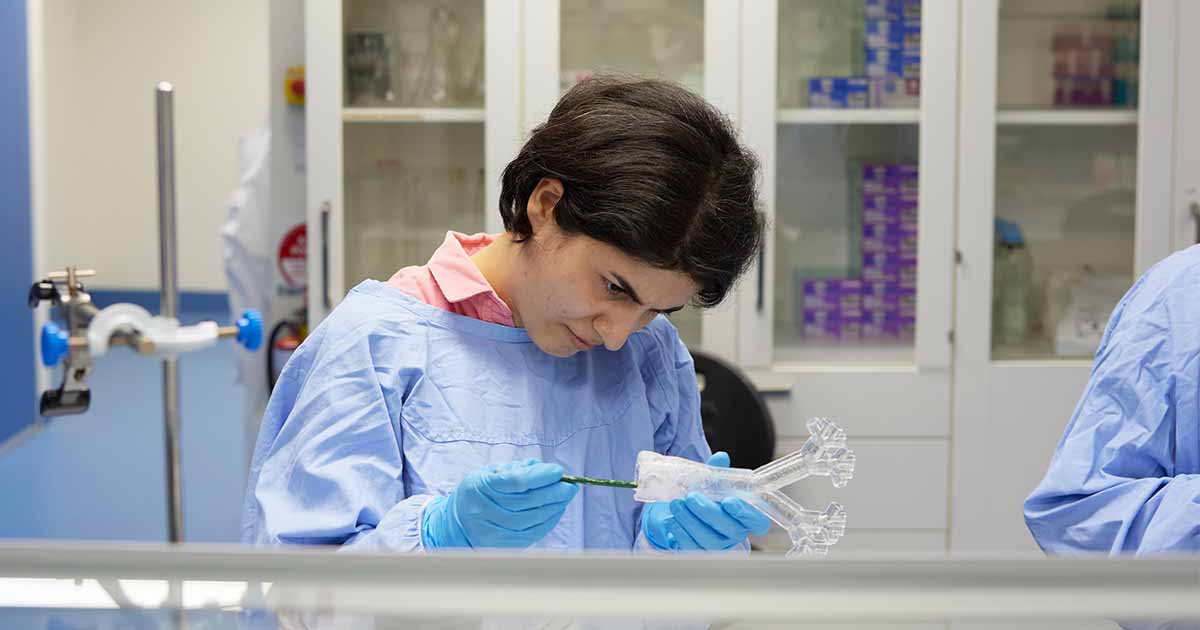
The team also recreates the human respiratory tract in the laboratory using technologies ranging from 3D printing, bioprinting, and microfluidics. These approaches allow the team to build models at very different scales, from anatomically realistic replicas of the nose, throat, and lungs to miniaturised airway models containing living human cells.
These models are then combined with imaging, computational fluid dynamics, and emerging AI approaches to investigate and predict how air and aerosol particles move through the complex pathways of the respiratory system. Living airway models take the research one step further towards understanding what happens after the medicine lands on the airway tissue and reaches the blood stream.
By following an inhaled medicine from formulation and aerosol generation through to deposition and interaction with airway tissue, RespiTech researchers are helping bridge the gap between laboratory development and clinical translation. The goal is to use this knowledge to design and evaluate inhaled medicines more effectively and ultimately help promising therapies make the journey from lab to lungs.
Find out more
Share online
Donate
We are committed to understanding and eradicating these conditions. If you would like to support our research please click the donate button.

Subscribe
Sign up with your email address to receive quarterly newsletter updates, including the latest medical findings and breakthroughs in respiratory and sleep research.
We Need Volunteers for our research











PRIVACY: The Woolcock Institute of Medical Research recognises the importance of your personal information and privacy. We will use your provided details only to contact you about information we believe will be of interest to you. Read our full Privacy Policy.
Woolcock Institute of Medical Research is a not-for-profit charity. Donations of more than $2 are tax deductible. Copyright © 2026. ABN: 88 002 198 905