
The Woolcock Institute of Medical Research
What dreams may predict
Being woken suddenly by your partner during the night can be alarming. Equally alarming is what it could predict about their future brain health. Associate Professor Elie Matar explains what we already know and what a new study at the Woolcock hopes to uncover.
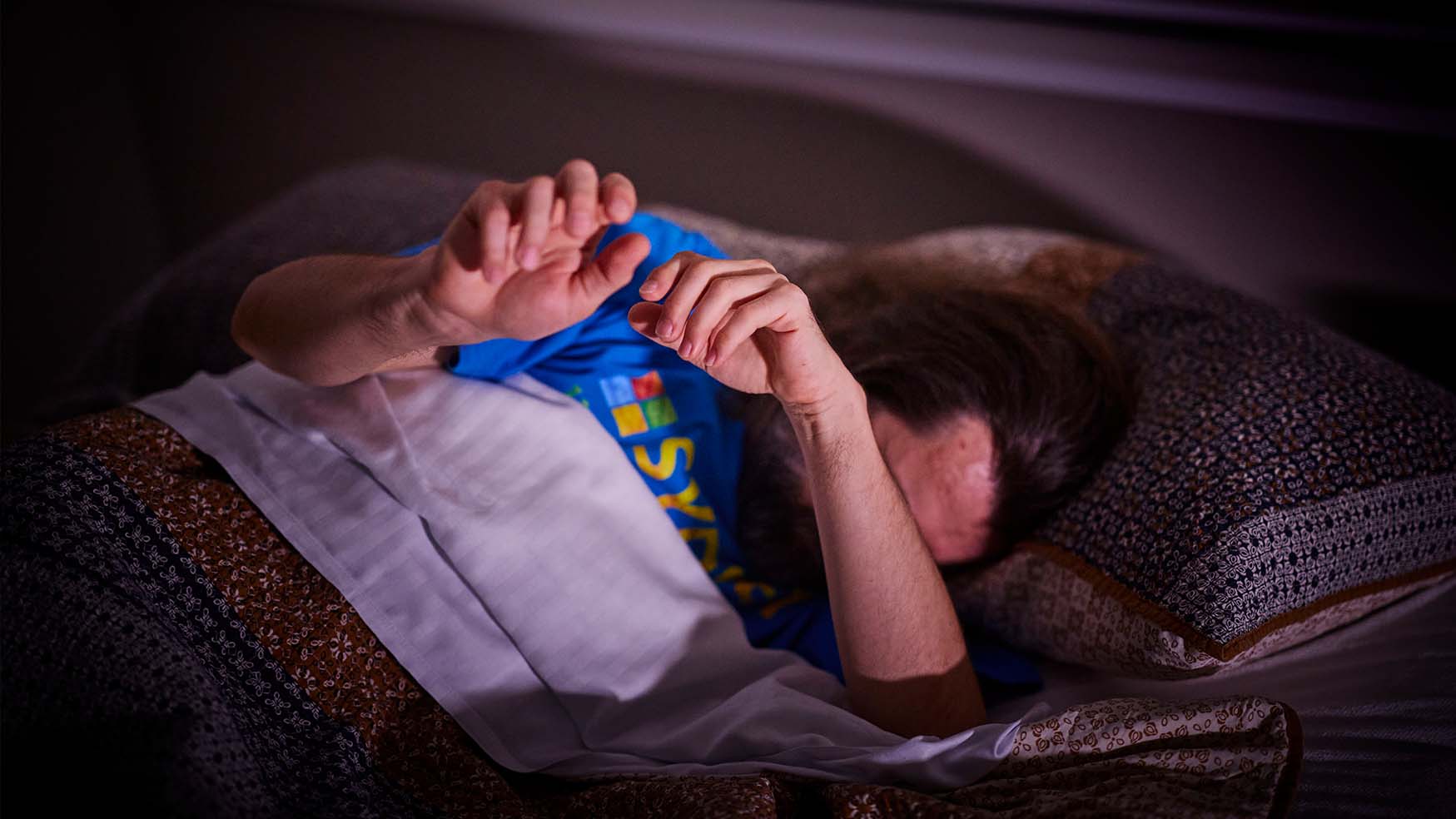
Sometimes the first person to notice a sleep disorder is the person on the other side of the bed. They might hear their partner shout, laugh, kick or see them reach out to catch something. Woken up, their partner may recall a dream that explains the movement perfectly.
During rapid eye movement (REM) sleep, when many of our most vivid dreams occur, most of our muscles are temporarily switched off. In REM sleep behaviour disorder (RBD), that process is incomplete and people can physically act out their dreams. When this happens without an identified cause such as a medication known to cause this or another neurological diagnosis, we call it isolated RBD, or iRBD.
For families, the immediate concern is often getting through the night safely. However, a diagnosis of isolated RBD can also be an indicator about one’s future brain health. Specifically, we now understand that iRBD can be the most specific clinical symptom preceding a future diagnosis of Parkinson’s disease or a related form of dementia called Dementia with Lewy bodies. What remains difficult to tell someone in the clinic is whether they will develop either condition, when that might happen and what changes to look for along the way.
At the Woolcock Institute of Medical Research and the University of Sydney, our team is working with people living with iRBD to answer those questions. Overnight sleep recordings allow us to measure brain waves and muscle activity as someone dreams. Specialised MRI scans let us examine a tiny region deep in the brain that helps us stay alert during the day. By bringing these measurements together and following people over time, we hope to understand why people with the same sleep diagnosis can have such different experiences.
This year, our team at Royal Prince Alfred Hospital performed Australia’s first synuclein skin biopsies. A small sample of skin allows us to look for an abnormal form of a protein called alpha-synuclein in the fine nerves beneath the skin. We have now detected it in our first samples. Through our SYN-BIO study, we are investigating what this finding can tell us when considered alongside a person’s symptoms, sleep recordings and brain scans.
Want to stay up to date with our research on sleep and respiratory conditions?
Sign up to our quarterly newsletter
We are also working to improve how iRBD is recognised in the first place. With the Sydney Health Partners Sleep Clinical Academic Group, we have surveyed sleep scientists and physicians across Australia about how they measure and report muscle activity during REM sleep. We are comparing automated measurements from more than 1000 sleep studies with detailed scoring by hand in 150 recordings. This work is helping us refine our local protocols and develop a more consistent national approach, so that wherever someone has their sleep study, their GP receives a clear account of what was found and what it might mean.
We are recruiting people with isolated RBD as well as those over the age of 60 who have no symptoms as healthy controls for a study which aims to deepen our understanding of the underlying brain mechanisms at play and help develop more targeted treatment options and management plans.
If you have been diagnosed with iRBD and would like a clinical review or want to take part in research, contribute to a better understanding of the condition and eventually help to slow it down, please refer to Associate Professor Elie Matar, the Woolcock’s Sleep and Circadian Research group or the University of Sydney Research Team (Sleep Wake and Neurodegeneration Group, swan.lab@sydney.edu.au). GPs and sleep physicians are also welcome to get in touch about a potential patient or participant.
If you or your partner regularly acts out dreams and you have never discussed it with a doctor, your GP is a good place to start.
Find out more
Share online
Donate
We are committed to understanding and eradicating these conditions. If you would like to support our research please click the donate button.

Subscribe
Sign up with your email address to receive quarterly newsletter updates, including the latest medical findings and breakthroughs in respiratory and sleep research.
We Need Volunteers for our research











PRIVACY: The Woolcock Institute of Medical Research recognises the importance of your personal information and privacy. We will use your provided details only to contact you about information we believe will be of interest to you. Read our full Privacy Policy.
Woolcock Institute of Medical Research is a not-for-profit charity. Donations of more than $2 are tax deductible. Copyright © 2026. ABN: 88 002 198 905